Whenever Jakarta gets too hot and too busy, people there say the same thing: go to Bandung. The capital of West Java sits on a plateau at roughly 780 metres, surrounded by volcanoes and tea hills, and it has a reputation for good food, cool cafés and cheap shopping. My friend and I finally made the trip at the end of the rainy season, giving it three days: one for the volcanic highlands south of the city and the rest for walking, eating and coffee.
Getting There
We took the Whoosh high-speed train from Jakarta, and it was so fast that we had barely opened our snacks before it was time to get off. Inside the city, Grab cars and Grab bikes are the easiest way around. The traffic in Bandung is heavy, so for short hops a motorbike taxi is often quicker than a car.
The first thing I noticed was the temperature. Many cafés here have no air-conditioning at all, just high ceilings and open windows, and they still felt comfortable. After Jakarta, that alone made me happy.
Day Trip South: Kawah Putih and the Tea Hills
The Road to Ciwidey
The highlands of Ciwidey are a couple of hours south of the city, depending on traffic, so we hired a driver and left at 6 am. The attractions get crowded by mid-morning, and the road is narrow, steep and full of sharp bends, but also beautiful, with small villages on the slopes, thin mist in the valleys and more and more green tea bushes the higher you climb. We stopped for coffee at a roadside café with a view over the valley before continuing up.
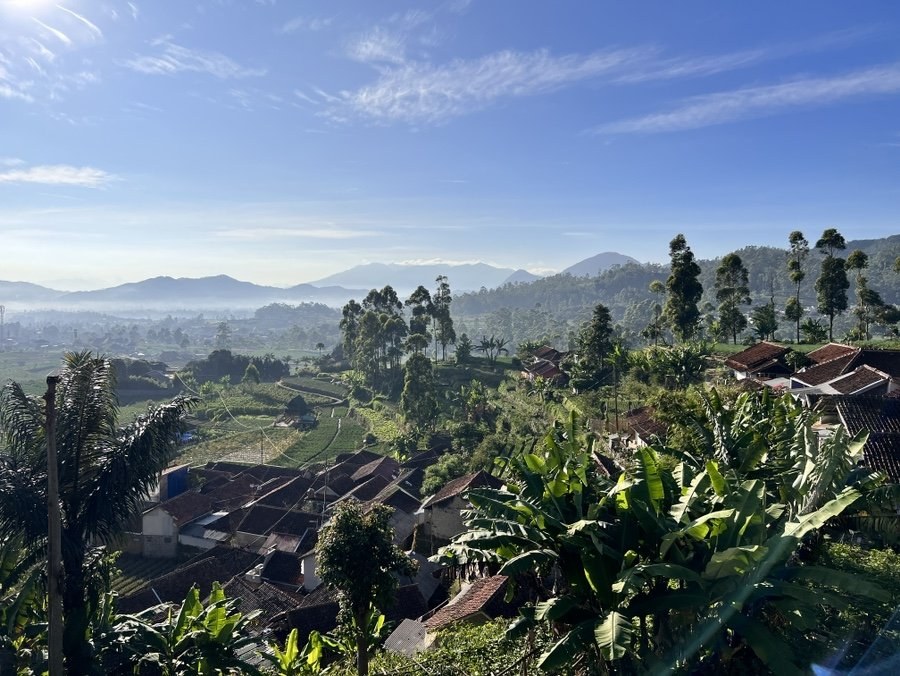 Morning view over a misty highland valley on the road to Ciwidey
Kawah Putih
Kawah Putih, the “white crater”, is a volcanic lake inside the crater of Mount Patuha, at around 2,400 metres above sea level. It opens at 7.30 am. From the lower car park you ride the ontang-anting, a little open shuttle, about five kilometres up a rough, steep road to the crater. Private cars can drive to the upper car park, but that costs a lot more and the road is hard work for city cars, so we happily took the shuttle.
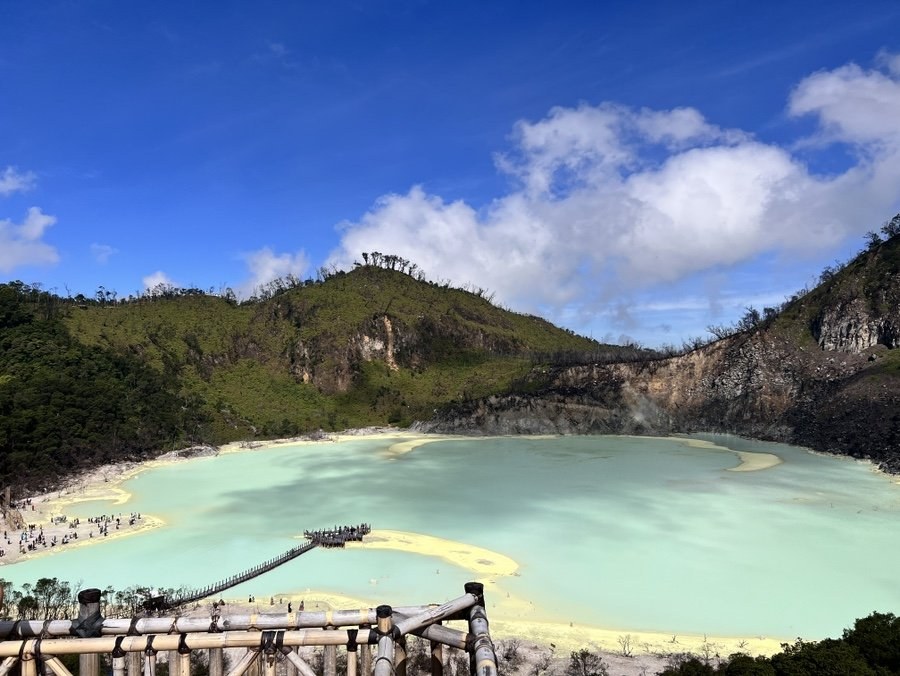 The pale turquoise crater lake of Kawah Putih surrounded by green volcanic hills
At the top, a long staircase leads down to the shore, and then the view opens up: a lake of milky turquoise water, pale yellow-white sand and a ring of rocky cliffs. The colour comes from the sulphur in the water and soil, and it changes with the weather, from greenish to almost pale blue. Local legend says no birds would fly over the crater, and it was a German scientist in the 19th century who worked out that the sulphur was the reason.
The sulphur smell is not too strong in most places, but it can give you a headache in some spots, so bring a mask and do not stay too long. Near the bottom of the stairs it was crowded with groups taking photos, so we turned right and walked to the far end of the path, where it was much quieter. There is also a newer floating bridge and a treetop Sky Walk with a viewing deck, which need an extra ticket.
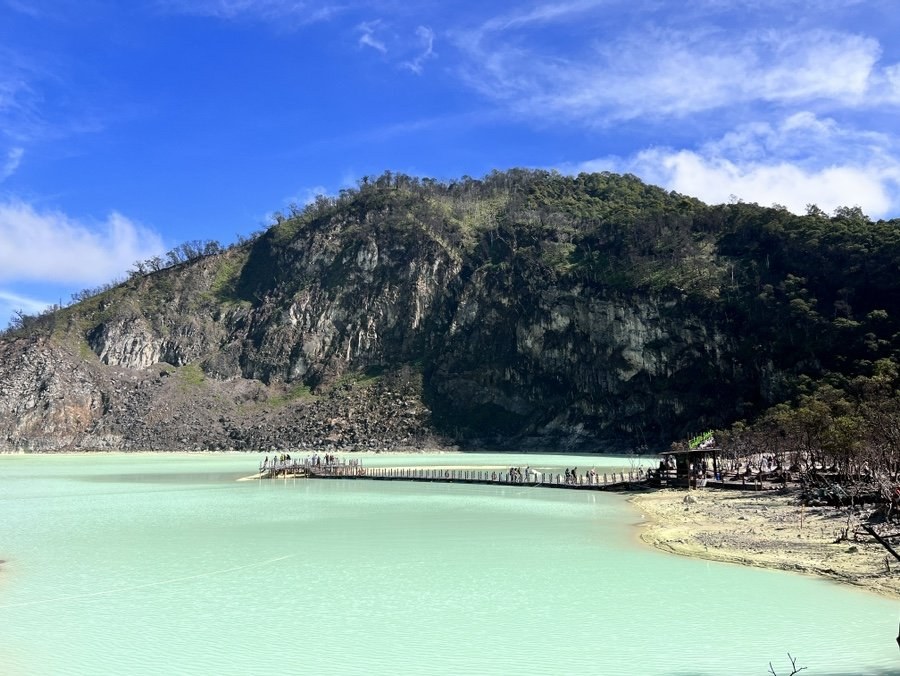 A wooden boardwalk stretching across the milky green water of Kawah Putih
Back at the car park, small warung serve simple Sundanese food. A plate of nasi timbel (rice wrapped in banana leaf) with sambal, fried tofu and grilled fish, plus a hot tea, tasted amazing in the cold mountain air. On the way down, stalls sell fresh strawberries, and many farms let you pick your own for around Rp80,000 per kilo (about $5 USD).
Rancabali Tea Plantation
The Rancabali tea estate covers the hills along the road below the crater. There is no single official viewpoint; people simply pull over to take photos. We stopped at Ecopark Curug Tilu, a small park with a waterfall, photo spots, a hilltop café and a long slide, all with the tea hills as a backdrop. Come in the morning or late afternoon if you can, because the midday sun is strong even up here.
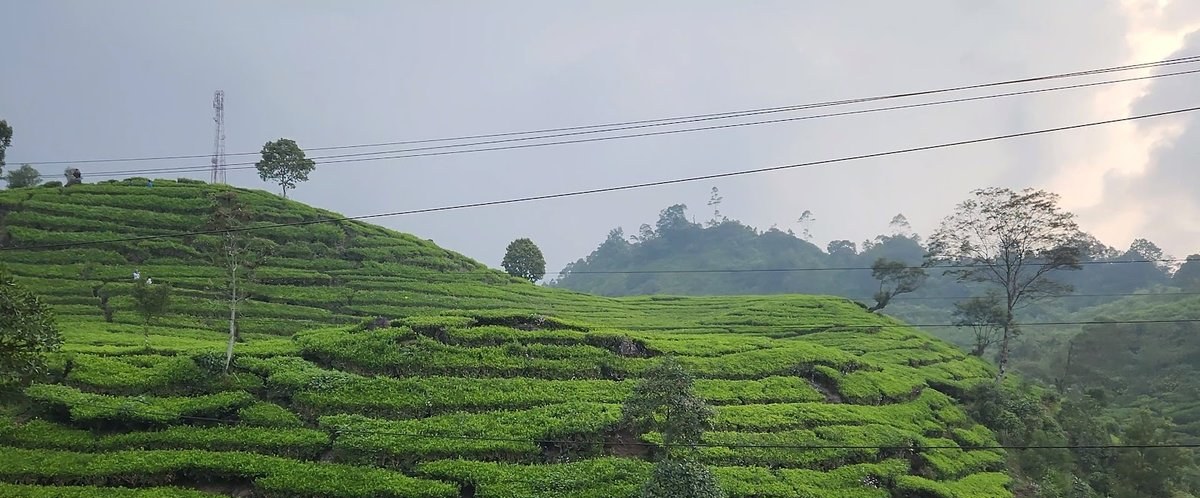 Neat rows of tea bushes covering the hills of the Rancabali estate
Bandung City: Old Streets, Cafés and Outlets
Jalan Asia Afrika and the Alun-Alun
Back in town we spent an afternoon walking around the old centre. Jalan Asia Afrika is named after the 1955 Asia-Africa Conference held here, and the museum about it sits on the street among elegant colonial buildings and ornate black street lamps. Further east is the Alun-Alun, the city square covered in artificial grass, where families sit and children run around, and right next to it the Grand Mosque with its two tall minarets. Visitors can go inside for a small donation.
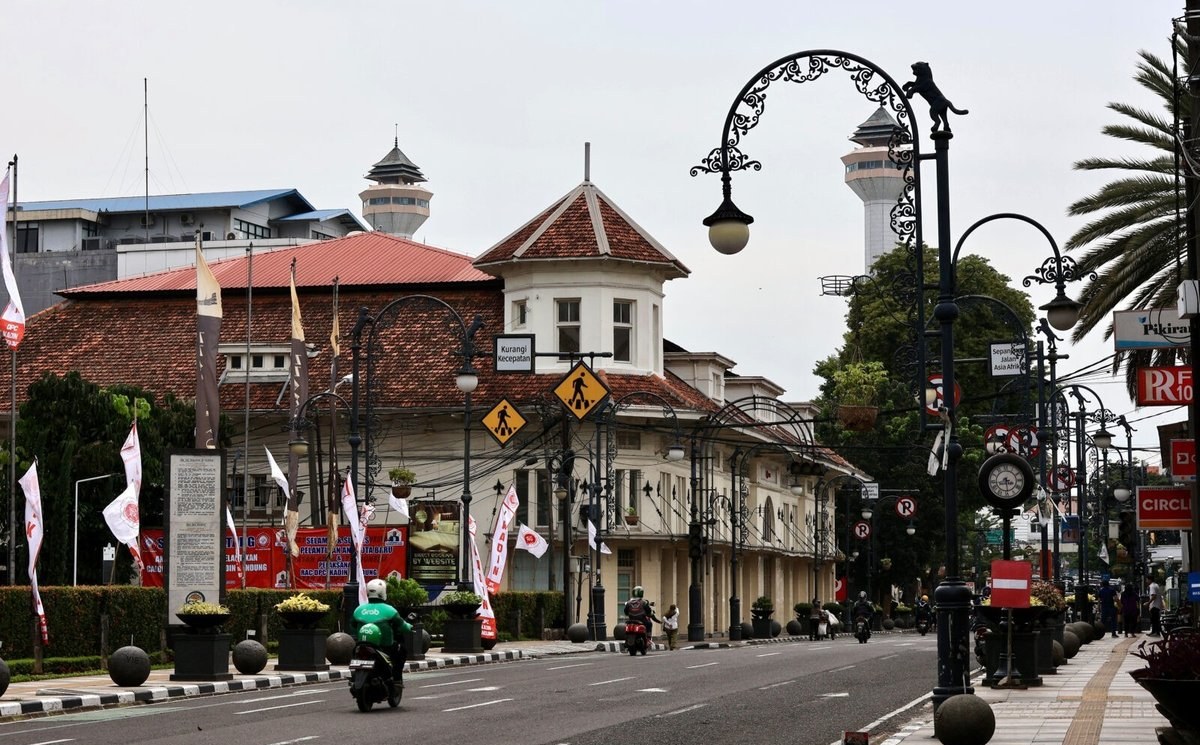 Colonial buildings and ornate street lamps along Jalan Asia Afrika with the Grand Mosque minarets behind
Braga Street
Turn the corner at the conference museum and you are on Jalan Braga, the most famous street in Bandung, lined with Dutch colonial buildings, galleries, cafés and bakeries. In the daytime it is busy with motorbikes and people. At dusk, when the old facades light up, it becomes really atmospheric. We had dinner at one of the restaurants on the street and then walked to a nearby night market for snacks.
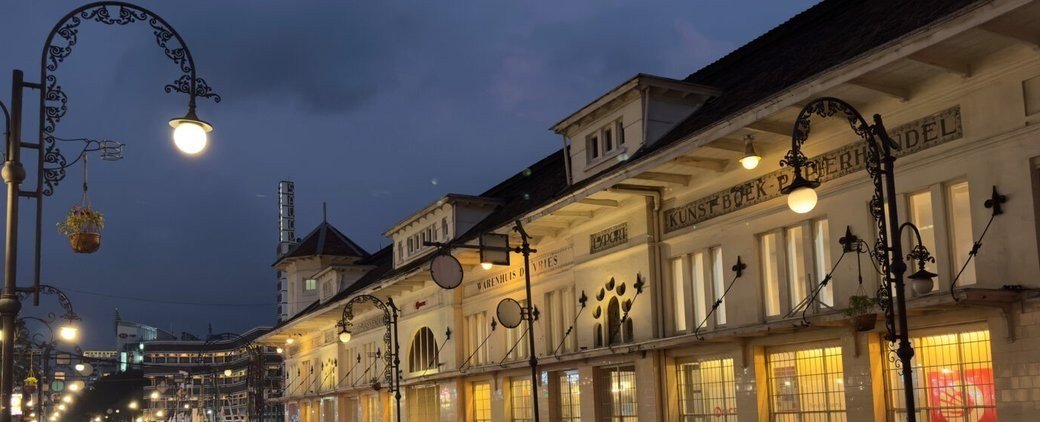 Lit-up colonial buildings and street lamps on Braga Street at dusk
Coffee, Factory Outlets and Street Food
Bandung takes coffee seriously, and we spent one morning hopping between roasteries with high ceilings and plenty of plants. Water comes free with your coffee. The city is also known for its factory outlets: there used to be many clothing and shoe factories around Bandung, and the outlets that grew out of them now sell surplus and brand-name stock. If you are patient, you can find good bargains.
For local food, try Tahu Gempol, a breakfast of tofu, fishcake and crackers with peanut sauce, sambal and bean sprouts, which costs very little. In the hilly forest park of Taman Hutan Raya north of the city, I bought a charcoal-grilled corn on the cob for about Rp15,000 (about $0.90 USD). Hold it tightly, because the monkeys there are quick!
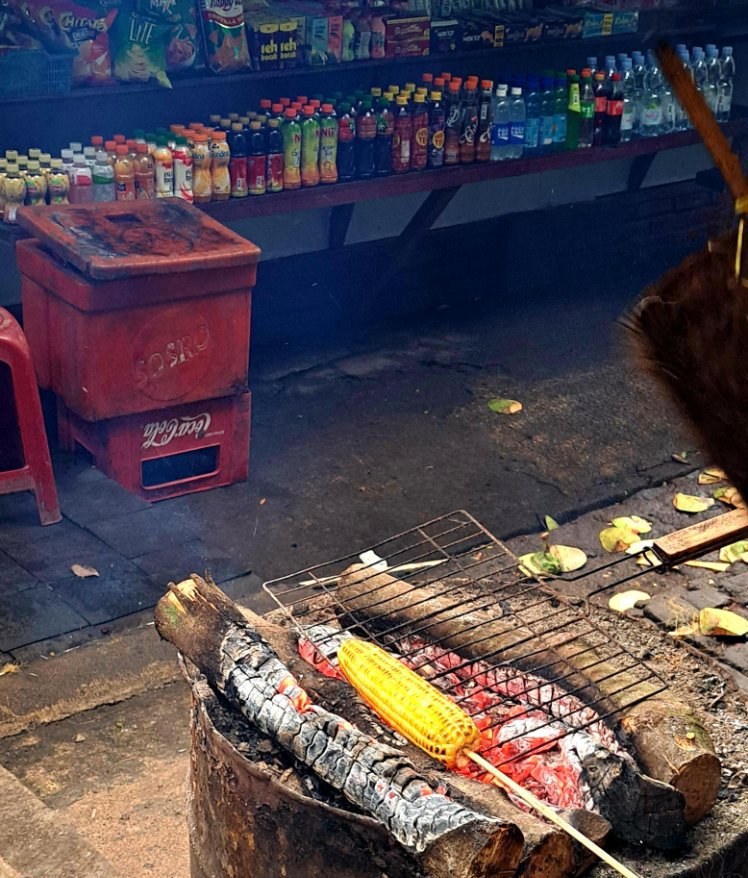 Corn on the cob roasting over charcoal at a street stall in Bandung
Tips for Bandung
- Start Kawah Putih early and bring a mask and a warm layer.
- Expect some rain in April and May, usually in the afternoon.
- Avoid long weekends, when the roads from Jakarta and to Ciwidey are jammed.
- Use Grab bikes for short trips in the city to beat traffic.
Final Thoughts
Bandung gave me two trips in one: a misty morning at a strange turquoise crater and among endless tea bushes, then easy days of colonial streets, good coffee and cheap snacks. It is cooler, calmer and greener than Jakarta, and I can see why people keep escaping here. Next time I want a whole day just for the cafés.